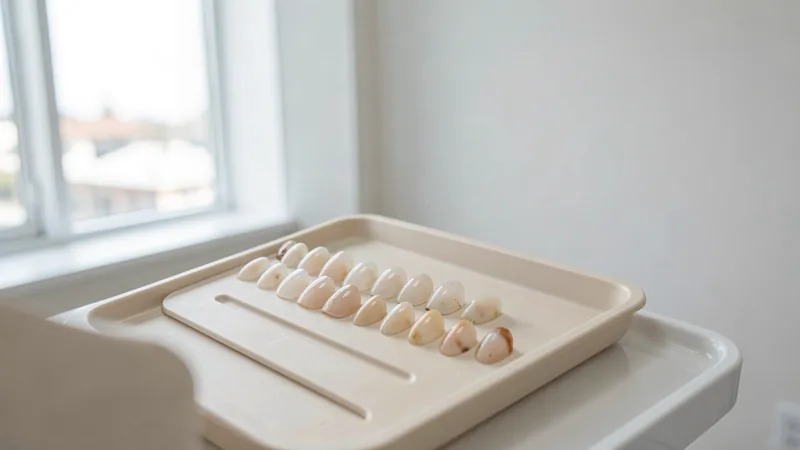
If you think a dental filling is still “drill, pack, and shape by hand,” modern dentistry has news for you. Advanced composite technology now lets dentists in Clarksville, Tennessee inject tooth-colored resin into a clear mold of your smile — like casting a miniature sculpture — for results far more precise than free-hand sculpting alone. Understanding what happens in the chair helps you recognize why some restorations last for decades while others fail, stain, or leak within a few years. Most people who read this are comparing biomimetic dentistry options around Clarksville, TN, so what follows sticks to the details that change in practice.
The hidden problems with traditional free-hand fillings
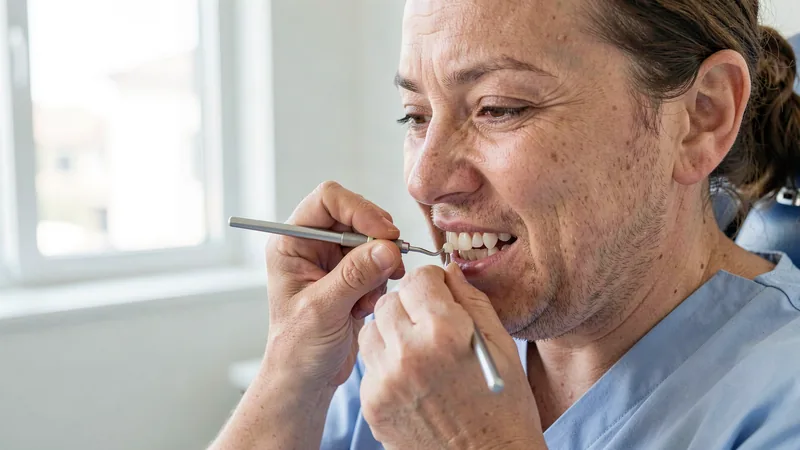
The short version
- Free-hand fillings fail mainly through hand-placement limits, leaving food-packing proximal contacts, trapped air bubbles, and micro-gaps that invite recurrent decay.
- Hand-polished surfaces often miss the critical smoothness threshold of Ra at or below 0.2 micrometers, so plaque attaches and stains accumulate faster.
- Injection molding uses a crystal-clear PVS matrix that passes 90% to 95% of curing-light energy, ensuring thorough monomer-to-polymer conversion.
- The every-other-tooth protocol waxes only alternating teeth and isolates neighbors with thin PTFE tape to prevent flash and bonding the arch into one block.
- Heating conventional composite to 155°F (68°C) temporarily lowers viscosity for flow, then it re-thickens on room-temperature tooth structure at full strength.
- A strict finishing sequence ends with a goat-hair brush and sub-micron aluminum oxide paste for a plaque-resistant, glazed-ceramic appearance.
Injection molding: copying a design instead of sculpting blind
The modern alternative is direct injection molding. The dentist designs your ideal smile — often with a digital wax-up — then transfers that design directly into your mouth using a crystal-clear, rigid polyvinyl siloxane (PVS) matrix. Composite is injected through small channels drilled at the incisal edges, and because the matrix is transparent, the dentist watches the material fill every corner in real time, eliminating air pockets and monitoring margins continuously. That transparency is clinically significant: highly translucent matrices allow 90% to 95% of the curing light's energy to pass through, ensuring thorough monomer-to-polymer conversion and maximizing the restoration's mechanical properties. The result is tight margins, high wear resistance, and minimal chairside adjustment.
The “every-other-tooth” safeguard
Restoring multiple front teeth at once creates a flash problem — composite overflowing into neighboring spaces, bonding the entire arch into a single, un-cleansable block. Skilled practices avoid this with an alternating protocol: a printed model waxes only every second tooth to its idealized final contour, so teeth are restored sequentially while adjacent teeth are isolated with thin PTFE tape during etching, bonding, and injection. The payoff is pristine, tight interproximal contacts with essentially zero interproximal flash — nothing for the dentist to grind away and nothing for plaque to hide in. Digital STL models combined with CBCT scans verify occlusion and vertical dimension before any material is placed.
Why heating composite to 155°F matters
Traditional injection techniques relied on flowable composites, which flow easily because they carry fewer filler particles. But lower filler loading means lower strength — which is why flowable materials are contraindicated in stress-bearing areas, at Class IV (front-corner) edges, and in patients who grind their teeth. The breakthrough: heating conventional, highly filled composite to 155°F (68°C) temporarily drops its viscosity so it flows into the matrix as smoothly as a flowable — then instantly re-thickens to its dense, strong state the moment it contacts room-temperature tooth structure.
| Property | Standard flowable composite | Preheated conventional composite (155°F) |
|---|---|---|
| Filler loading | Low | High (hybrid/microfilled) |
| Mechanical strength | Lower; contraindicated for heavy bite areas | Full strength; suitable for load-bearing anterior cases |
| Class IV edges & bruxism patients | Not recommended | Appropriate |
| Flow during injection | Flows at room temperature | Flows when warmed; re-thickens on the tooth |
| Long-term polishability | Limited | Excellent, high fracture resistance |
The finish that fights plaque
A mirror-smooth finish is not vanity — it is biology. Roughness attracts biofilms, causes staining, and irritates gums, so elite practices follow a strict finishing sequence: gross flash removal with a No. 12 scalpel blade and red-band finishing diamonds; proximal contouring with ultra-thin flexible polishing strips; pre-polishing with medium-grit silicone rubber points; a high-shine gloss polished at under 5,000 RPM with fine and ultra-fine diamond-impregnated cups; and a final luster glaze buffed with a goat-hair brush and sub-micron aluminum oxide paste for a plaque-resistant, glazed-ceramic appearance.
What this means for your next appointment
When a dentist uses preheated injection molding with a transparent matrix, you get fillings and veneers with tighter margins, fewer internal voids, higher strength, and a smoother, more stain-resistant surface. Clinically, that translates into fewer retreatments, less recurrent decay, and a smile that still looks freshly polished years later. Ask your dentist whether they use heated composite injection and a clear PVS matrix. Whether you are in downtown Clarksville or anywhere else in Tennessee, the same standards of material science should apply to your smile — because the technology that once belonged only to high-end smile makeovers is quietly transforming everyday restorations into precision work.
📄 Free Guide: The Dental Implant Blueprint1 — download the printable reference.